
A reverse tuxedo cat is a bicolor cat whose black-and-white markings are flipped from the standard tuxedo pattern. Instead of a mostly black coat with white limited to the paws, chest, and belly, the cat is mostly white, with black concentrated in patches over the back and ears and in a mask-like marking across the eyes and nose. Both patterns come from the same gene, the KIT gene’s white-spotting effect, which controls how much white overtakes a solid coat. A reverse tuxedo just has a smaller area affected by that gene, so black stays dominant instead of white.
Evidence-reviewed, not hands-on tested: the genetics and terminology below are drawn from veterinary genetics labs and breed registries, cited throughout, and then applied to one very photogenic real-world example.
What Causes the Reverse Tuxedo Pattern?
Cats get their black-and-white patterning from one gene family, not two traits competing for space. According to the UC Davis Veterinary Genetics Laboratory, the white-spotting gene (KIT) controls how far pigment-producing cells migrate across a kitten’s skin before birth. When migration goes almost all the way, you get a mostly black cat with a few white spots, the socks-and-bib look everyone calls a standard tuxedo. When migration stalls early, color gets pushed into a smaller area, usually the head, ears, tail, and a stripe down the spine, and white takes over everywhere else. That’s the reverse tuxedo. Same gene, smaller territory for the black.
Is that actually rare? There’s no population data either way. It just sits at a different point on a spectrum than the pattern most people picture when they hear “tuxedo cat.”
Tuxedo vs. Reverse Tuxedo vs. Van: How the Patterns Compare
Once you see the spectrum, the naming makes a lot more sense. Here’s how the main black-and-white patterns line up against each other.
The Cat Fanciers’ Association’s coat pattern glossary files every one of these under the general bicolor umbrella. Tuxedo, reverse tuxedo, and van aren’t separate patterns with separate genetics; they’re different stops along the same white-spotting scale. If patchy patterns fascinate you beyond black and white, our roundup of cat breeds with unique spotted or striped fur patterns covers the rest of that spectrum. And for more on the classic version of this pattern, see our 5 facts about tuxedo cats.
What Does a Reverse Tuxedo Cat Actually Look Like? Mickey’s Case
Out of nowhere, during what should have been a completely ordinary afternoon, Mickey delivered a moment so unintentionally dramatic it felt staged. He was perched on his favorite cat tree, lazily grooming his paw with the calm focus only cats seem to master. Then, mid-lick, he stopped. His tongue hovered. His body stiffened. His wide eyes locked onto something invisible in the distance.
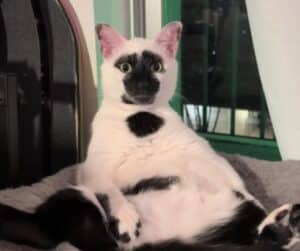
It wasn’t just the sudden pause that captured hearts. It was his face.
Mickey is a textbook example of the pattern above. Instead of the familiar black coat with neat white accents, his coloring is flipped: his body is mostly snowy white, splashed with bold black patches, and a dramatic black mask stretches across his eyes, nose, and mouth, as if someone painted it there.
The effect is unforgettable. He looks permanently startled, caught in one long moment of wide-eyed wonder.
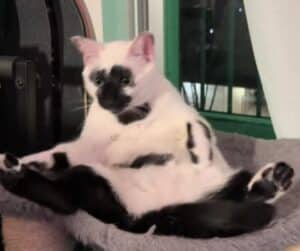
That frozen mid-lick expression only made it better. His bright eyes seemed to search for something beyond the room, ears alert, as though he was listening to a secret only cats can hear.
Movie-Star Drama, Reverse Tuxedo Style
The clip, shared by @mickeyginocats, quickly made its way across social media. Viewers couldn’t stop talking about his reversed tuxedo pattern, joking that someone had inverted the classic black-and-white palette and added a touch of theatrical eyeliner.
“Somehow the tuxedo is reversed in every place you’d think it would be,” one person wrote. Another playfully wondered whether he was black with white stripes or white with black stripes. Several viewers compared him to a lemur, a comparison that lines up neatly with his wild-animal-adjacent look, and honestly, the resemblance is charming.
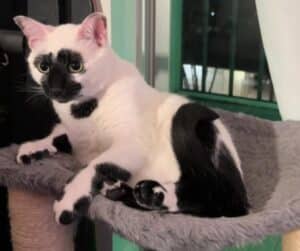
But beyond the jokes, there’s something sweet about Mickey. His bold markings give him a look of constant astonishment, but his body language tells a softer story: comfortable, safe, completely at ease high up on his cat tree. His pause didn’t come from fear. It felt more like curiosity, a tiny moment of feline wonder.
Cats are masters of the dramatic pause. A creak in the house, a flicker of light, a distant movement, any of it can turn into a full cinematic event. For Mickey, that ordinary afternoon likely held some small mystery worth investigating. And in that still frame, tongue frozen and eyes wide, he reminded everyone why cats are endlessly captivating.
Is a Reverse Tuxedo Cat’s Personality Different?
Searches for “reverse tuxedo cat personality” turn up a lot of opinion and very little science. Here’s the honest answer: there is no established genetic link between the reverse-tuxedo pattern, or any black-and-white pattern, and temperament. The closest available research is a 2016 UC Davis-led study in the Journal of Applied Animal Welfare Science, which looked for a connection between coat color and aggressive behavior in cats and found coat pattern was not a reliable predictor once other factors were accounted for. Reverse tuxedo cats like Mickey get called bold, expressive, or dramatic because that’s what people notice on video, not because the KIT gene reaches into personality.
What About a Reverse Siamese Cat?
“Reverse siamese cat” is a related search, but it actually points to a different gene entirely. Classic Siamese coloring comes from a temperature-sensitive form of albinism, not white spotting: the enzyme that makes pigment only works properly on the cooler parts of the body, the face, ears, paws, and tail, which is why those areas darken into points while the warmer torso stays pale. According to the UC Davis Veterinary Genetics Laboratory’s colorpoint test page, that gene is separate from the KIT white-spotting gene behind tuxedo and reverse tuxedo patterns. Siamese cats are also famous for the striking blue eyes tied to this same gene family, a trait we cover in more depth in our piece on why kittens are born with blue eyes. A cat described online as a reverse siamese usually just has its point-and-body colors swapped in appearance, dark body, pale face, rather than the underlying mechanism actually flipping. It’s a nickname, not a documented distinct pattern the way reverse tuxedo is.
@mickeyginocats Heard a noise mid-groom 👀 Literally Meow – Trendify