
Tuxedo cats walk into a room and steal the spotlight without trying. That striking black-and-white coat pattern gives them a built-in formal look that’s impossible to ignore. But there’s a lot more going on with these cats than just good fashion sense.
Here’s what surprises most people: tuxedo cats aren’t a breed. They’re a color pattern, and it shows up across dozens of different breeds with wildly different personalities, body types, and temperaments. Whether you already share your home with one or you’re thinking about adopting, here’s what makes tuxedo cats so interesting.
What Exactly Makes a Cat a “Tuxedo” Cat?
The name comes from the coat pattern itself. A tuxedo cat has a primarily black (or dark-colored) coat with white patches on the chest, stomach, paws, and sometimes the chin or face. The white markings sit against the darker fur the same way a white dress shirt sits under a black suit jacket.
The classic version is black and white, but the pattern isn’t limited to those colors. Gray and white tuxedos exist. So do orange and white variations, though purists might argue about the name at that point, alongside plenty of other cat coat patterns with similarly bold contrast. The key feature is the contrast: a darker body with lighter markings concentrated on the front.
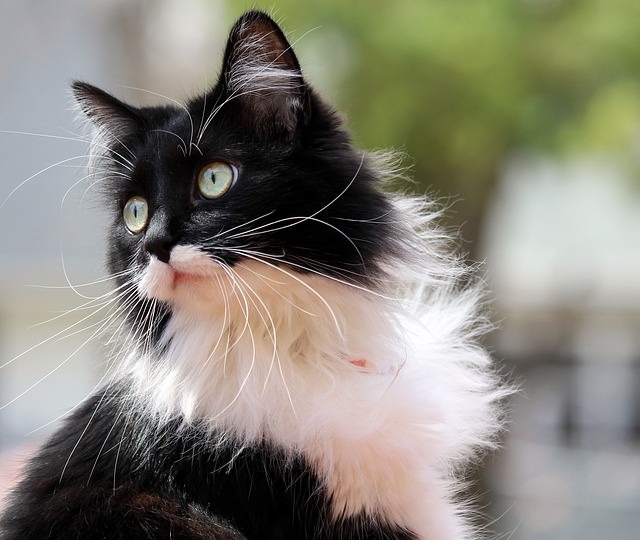
No two tuxedo cats look exactly the same. Some have perfectly symmetrical markings that look painted on. Others have splotches, uneven borders, or a white “mustache” that gives them a permanently surprised expression, the same kind of gene expression covered in how cats get their white socks. That genetic randomness is part of the appeal.
The Genetics Behind the Tuxedo Pattern
Tuxedo cats are genetically classified as piebald or bi-colored. The white patches come from the white spotting gene (known as the S gene), which suppresses pigment production in certain areas of the coat during embryonic development, according to the UC Davis Veterinary Genetics Laboratory. The exact placement of white patches is partly random, which explains why even kittens from the same litter can have very different markings.
The amount of white on a tuxedo cat varies. Low-grade white spotting produces the classic “tuxedo” look with white limited to the chest and paws. Higher-grade white spotting creates cats that are mostly white with dark patches, which is technically a different pattern called “van” or “harlequin.”
Tuxedo Cat Quick Facts
- Pattern type: Bi-color (piebald), not a breed
- Genetic basis: White spotting gene (S gene)
- Classic colors: Black body with white chest, paws, and sometimes chin
- Gender split: Roughly equal between male and female (unlike calico/tortoiseshell)
- Breeds where tuxedo appears: American Shorthair, British Shorthair, Maine Coon, Persian, Cornish Rex, Norwegian Forest Cat, and many mixed breeds
One interesting genetic note: unlike calico and tortoiseshell cats, the tuxedo pattern isn’t sex-linked. You’ll find roughly equal numbers of male and female tuxedo cats. Calico cats are almost always female because their three-color pattern requires two X chromosomes, but the tuxedo gene doesn’t have that restriction (PetMD).
Which Cat Breeds Can Have the Tuxedo Pattern?
Since tuxedo is a color pattern and not a breed, it pops up across a surprising range of cat breeds. No breed standard specifically calls for the tuxedo look, but many breeds produce it naturally.
The most common breeds where you’ll spot tuxedo markings include:
- American Shorthair: one of the most frequent tuxedo carriers
- British Shorthair: produces tuxedos with a stockier, rounder build
- Maine Coon: tuxedo Maine Coons are striking given their large size and fluffy coats
- Persian: tuxedo Persians combine the flat face with formal markings
- Cornish Rex: curly-coated tuxedos with a distinctive body type
- Norwegian Forest Cat: big, fluffy tuxedos built for cold climates
- Scottish Fold: the folded ears plus tuxedo markings create an unforgettable look

Mixed-breed cats are probably the most common tuxedos of all. Walk through any animal shelter and you’ll likely spot at least one black-and-white cat with that unmistakable formal coat pattern waiting for a home.
Famous Tuxedo Cats Throughout History
Where Did Tuxedo Cats Come From?
Tuxedo cats don’t trace back to one place or one moment. The white spotting (S) gene that creates the pattern shows up across nearly every population of domestic cat, not one regional bloodline, which is part of why it’s so widespread today.
So where does the black-and-white look actually come from? Research into historic coat-color gene frequencies points to Western Europe and Mediterranean port cities as an early hotspot for white spotting, likely because cats (and their genes) traveled the trade and shipping routes that connected those ports for centuries (Todd, N.B., “Cats and Commerce,” Scientific American, 1977). That history helps explain why tuxedo markings turn up in so many unrelated breeds today, from British Shorthairs to Maine Coons, instead of being tied to a single lineage.
Tuxedo cats have also been charming humans for centuries, at least according to popular accounts. Historical anecdotes describe William Shakespeare, Beethoven, and Sir Isaac Newton as cat owners with a fondness for black-and-white cats, though these particular stories are largely undocumented folklore rather than confirmed historical record.
Something about that dapper black-and-white look apparently appeals to creative geniuses.
In the White House, the Clinton family’s cat Socks became one of the most famous felines in American political history. Socks was a classic tuxedo who lived at 1600 Pennsylvania Avenue from 1993 to 2001 and received tens of thousands of fan letters. The exact tally is hard to verify today, but the William J. Clinton Presidential Library confirms Socks was among the most popular pets in White House history and drew heavy fan mail throughout his residency.
Pop culture is full of tuxedo cats too. Sylvester from Looney Tunes, with his black body and white face, is probably the most recognizable cartoon tuxedo cat ever created. Magical Mr. Mistoffelees from Andrew Lloyd Webber’s musical “Cats” is another famous tuxedo.
Felix the Cat, one of the earliest cartoon characters from the silent film era, also sports the classic pattern.
Famous Tuxedo Cats You Might Know
- Socks Clinton: lived in the White House from 1993-2001
- Sylvester: the Looney Tunes cat who chased Tweety Bird for decades
- Felix the Cat: one of the first cartoon characters in film history
- Mr. Mistoffelees: the magical tuxedo cat from “Cats” the musical
- Dr. Seuss’s Cat in the Hat: arguably the most famous fictional cat, with a tuxedo-inspired design
Tuxedo Cat Personality: Is There Really a “Tuxedo Temperament”?
Coat color alone does not decide a tuxedo cat’s personality. A cat’s temperament comes mostly from breed background, early socialization, individual experience, and environment, not from a black-and-white coat pattern.
Cat owners still love to assign personality traits to coat colors. You’ll hear that orange cats are friendly goofballs, black cats are mysterious, and tuxedo cats are feisty or extra affectionate. Is any of it true? Not in a strict genetic sense. A tuxedo Maine Coon will behave very differently from a tuxedo Siamese mix, because breed influence matters far more than the color pattern. That holds whether you’re searching for tuxedo cat personality, bicolor cat personality, or gray tuxedo cat personality specifically.
That said, a 2015 study from the University of California, Davis, published as Stelow, Bain, and Kass, “The Relationship Between Coat Color and Aggressive Behaviors in the Domestic Cat,” in the Journal of Applied Animal Welfare Science (2016), found that owners consistently reported more aggressive behavior in calico and tortoiseshell cats compared to other color patterns, while solid-colored and tuxedo cats rated lower on aggression scales (Stelow et al., 2016). The researchers cautioned that owner perception and expectation bias could play a role, but the finding was statistically significant.
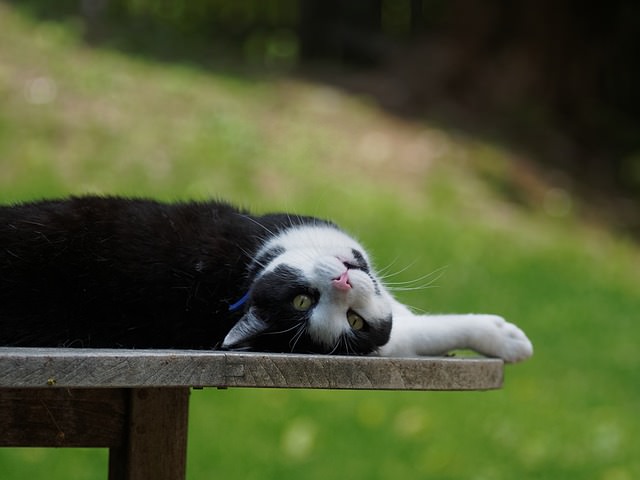
So what do most tuxedo cat owners actually agree on? Their cats have strong personalities. They tend to be vocal, confident, and social. Whether that’s genuinely linked to the genetics behind the tuxedo pattern or just a reflection of how much attention these visually striking cats get from their owners is still an open question.
Tuxedo Cats and Their Place in Shelters
Black-and-white cats, including tuxedos, sometimes face longer shelter stays than cats with more “unusual” coloring. The phenomenon is called “black cat syndrome,” and while it primarily affects solid black cats, bi-colored cats with significant black markings can experience it too, according to shelter-outcome research (Svoboda & Hoffman, 2015, Animal Welfare).
The good news: tuxedo cats tend to photograph better than solid black cats because the white markings give the camera something to focus on. Shelters that invest in good adoption photos often find that tuxedo cats with unusual markings get adopted faster because their unique patterns catch people’s attention online.
If you’re considering adopting a tuxedo cat, check your local shelters first. These cats are common in rescue populations, and you’ll likely find one with a personality that clicks with yours.
Health Considerations for Tuxedo Cats
Since “tuxedo” is a pattern and not a breed, there aren’t any health issues specific to the tuxedo coloring itself. The white spotting gene that creates the pattern doesn’t carry known health risks the way the white gene in all-white cats can (all-white cats, especially those with blue eyes, have a higher risk of deafness, per Strain, G.M., LSU deafness research).
Your tuxedo cat’s health risks will depend primarily on breed background, genetics, diet, and lifestyle, which is why it helps to know which of the healthiest cat breeds your tuxedo might be mixed with. A tuxedo Persian will have different health concerns (respiratory issues, kidney disease) than a tuxedo American Shorthair (generally hardy with fewer breed-specific problems).
Standard preventive care applies: regular vet checkups, vaccinations, dental care, quality nutrition, and indoor or supervised outdoor access. None of that changes based on coat color.
How to Care for a Tuxedo Cat’s Coat
Tuxedo cats don’t need special grooming beyond what’s typical for their breed. Short-haired tuxedos (the most common type) do well with weekly brushing to remove loose fur and reduce hairballs. Long-haired tuxedos, like those from Maine Coon or Norwegian Forest Cat lines, need more frequent grooming to prevent matting.
White fur stains more visibly than dark fur, and it shows. If your tuxedo cat has white paws, you might notice yellowish discoloration around the nails or on the paw pads. This is usually just from litter box use and cleans up easily with a damp cloth. Tear staining around the eyes can also show up more on white facial markings.
A good flea prevention routine is especially important for cats with white fur patches, since flea dirt (those tiny black specks) shows up very clearly against white fur and can be an early visual indicator of a flea problem.

Why Tuxedo Cats Keep Winning Hearts
There’s something about a cat that looks like it’s permanently dressed for a formal event. Tuxedo cats combine visual charm with the full range of feline personalities, and they show up in enough breeds that you can find one to match almost any lifestyle preference.
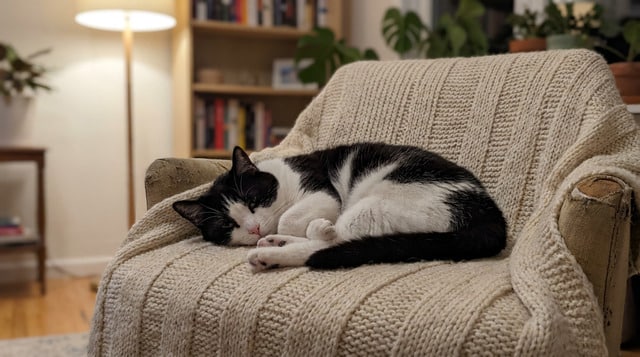
Whether you’re drawn to the history, the genetics, or just the way they look curled up on your couch, tuxedo cats are worth getting to know. They’re common enough that adopting one is easy, and individual enough that no two will ever be quite the same.
If you’ve got a tuxedo cat at home, you already know. They don’t just wear the suit. They own it.
This content was created with AI assistance and edited by the iHeartCats team.