
Maeve Maureen has the proportions of a tiny kitten, the confidence of a much larger cat, and an approach to personal safety that her family lovingly compares to that of a dodo bird. She bounces, stumbles, attempts enthusiastic pounces, and occasionally seems surprised by the basic mechanics of being a cat. Watching her play, it would be easy to assume she is simply a very young kitten still figuring everything out.
Maeve’s tiny size, however, is part of something much more unusual. The Australian rescue cat has pituitary dwarfism, also known as hyposomatotropism, a rare condition associated with inadequate growth hormone production. Her family created a social media account devoted to documenting life with Maeve and raising awareness about a condition many cat lovers have probably never encountered.
That educational mission comes wrapped in an irresistible little package. Maeve may require careful monitoring as she develops, but she is also busy proving that being different leaves plenty of room for purrs, playtime, impressive bursts of speed, and one particularly funny friendship with a dog who makes her look even smaller. Her life today is especially remarkable considering just how vulnerable she was when someone first spotted her alone beside a road.
Maeve Was Just 200 Grams When Someone Found Her
Maeve’s story began on April 28, when a kind woman discovered a tiny stray kitten outside without a mother or littermates anywhere nearby. She weighed only about 200 grams and was in desperate need of help. Fleas covered her little body, one eye was crusted and sealed shut, and congestion from an upper respiratory infection made breathing more difficult.
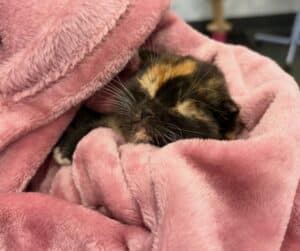
Outside, cold weather and powerful winds made the situation particularly dangerous for such a young kitten. Once she was brought somewhere warm, Maeve curled into a blanket and settled down, finally getting some relief from the harsh conditions she had been enduring.
Veterinarians estimated that Maeve was only around a week and four days old. At that age and without her mother, she required intensive care, including bottle feedings approximately every 30 minutes. Her caregiver brought her home and watched over her through the night, providing the warmth, food, and attention the tiny orphan could not have survived without for long.
Maeve had already overcome enormous odds simply by being found in time. As the days passed, however, her family began to realize there was something unusual about their new little rescue.
Maeve Wasn’t Growing Like an Ordinary Kitten
Maeve was eventually identified as having feline pituitary dwarfism, also known as hyposomatotropism. The pituitary gland is a small but enormously important gland near the brain that produces hormones involved in numerous functions throughout the body, including growth.
Pituitary dwarfism is uncommon in cats, which is one reason Maeve’s family decided to document her development publicly. By sharing the realities of caring for her, they hope to introduce more people to a condition many animal lovers have never heard of while also recording Maeve’s individual progress.
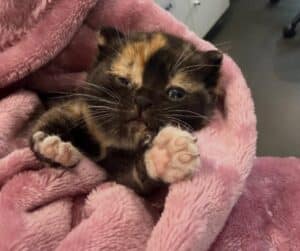
Her family is watching much more than the number on a scale. Maeve’s mobility, coordination, and general development are important parts of understanding how she is doing, especially as they remain alert for changes that could indicate additional health concerns. For Maeve, however, being carefully monitored does not appear to interfere with her busy schedule of being extremely tiny and getting into things.
Her Brain Just Needs a Little Morning “Kickstart”
Mornings with Maeve begin with affection and playtime, which her family says helps warm her up and get her ready for the day. Those sessions also reveal another side of the miniature cat, as Maeve happily purrs while receiving some attention from her favorite people.
Her family jokes that Maeve’s little brain sometimes needs a “kickstart” before she gets going. Once she does, however, Maeve has plenty of plans. She loves frolicking around with an enthusiastic combination of bouncing and stumbling, and while her movements can occasionally look a little unconventional, anyone assuming her tiny legs make her slow may want to reconsider. Her family says Maeve can be surprisingly fast when she wants to be.
Her hunting technique remains a work in progress. Maeve is practicing her pounces, although she has apparently not yet fully grasped that a pounce generally works best when there is a specific target. Her family also affectionately reports that she possesses approximately the survival instincts of a dodo bird.
Thankfully, Maeve lives somewhere that allows her to be wonderfully terrible at survival. Her family isn’t expecting perfection from their unusual little cat because, as far as they are concerned, she is already “perfectly perfect.”
Her Giant Canine Brother Makes Maeve Look Even Tinier
If someone wanted to emphasize just how small Maeve is, they could place her next to an ordinary adult cat. Her family has access to a substantially more entertaining comparison in the form of Buddy, Maeve’s canine big brother and a Great Dane mix.
The size difference between the pair is almost comical. Beside the large dog, Maeve appears even more miniature than usual, creating an unlikely sibling duo that her family says regularly makes them laugh.
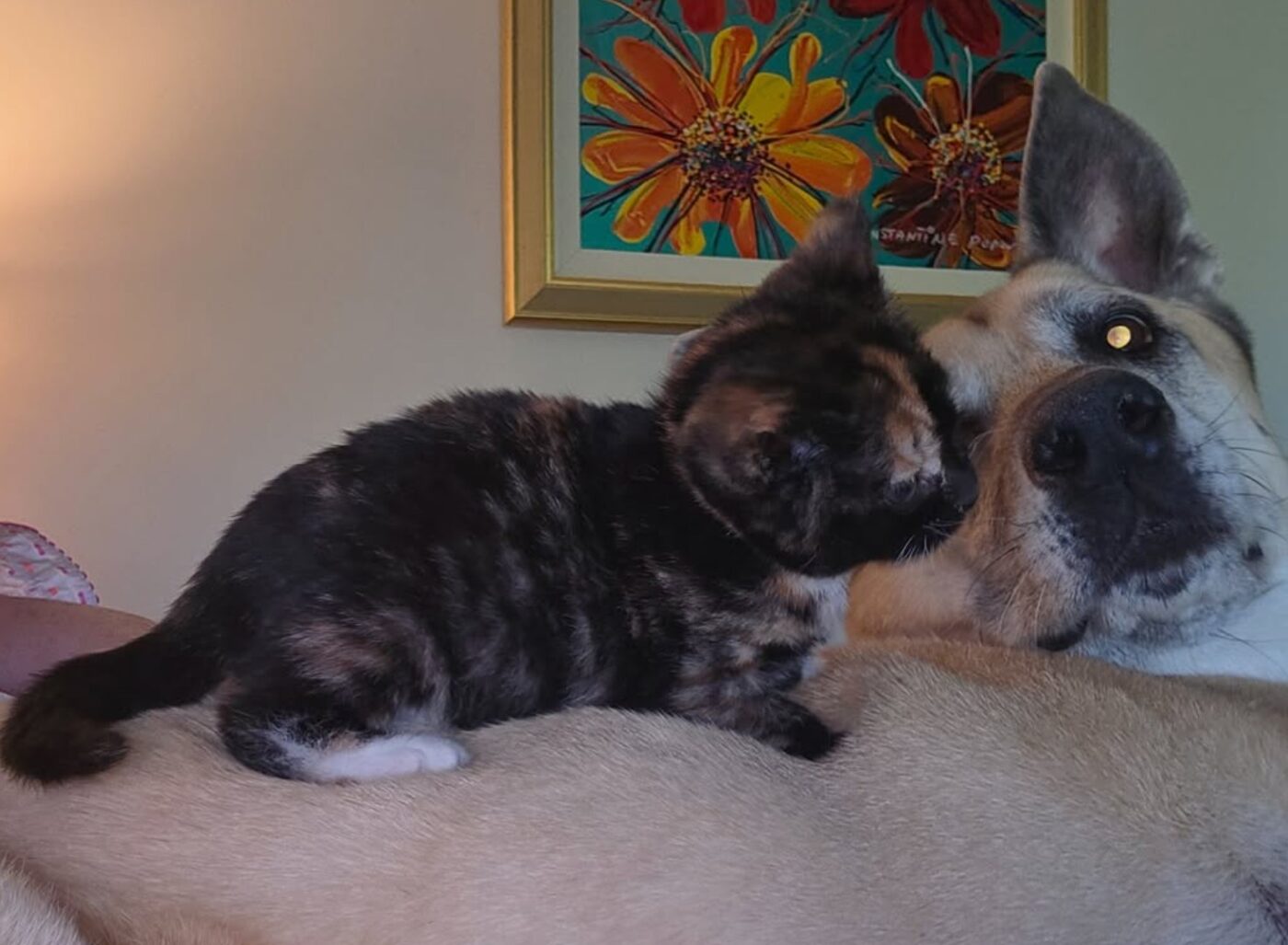
There is also something especially sweet about their relationship. Maeve entered life alone and vulnerable, without her mother or littermates beside her. Now the little rescue kitten has a family watching over her and a very large canine brother sharing her world. Maeve may be miniature, but her support system certainly isn’t.
Pituitary Dwarfism Is About More Than Being Tiny
Maeve’s story also offers an opportunity to explain why pituitary dwarfism involves more than simply producing an unusually small cat. The pituitary gland produces hormones that influence important processes throughout the body, which means a disorder involving that system can potentially have effects beyond an animal’s size.
That is why monitoring Maeve’s overall development remains so important. Her family pays particular attention to her mobility and coordination, watching how she moves as she plays, explores, and grows. Changes in those abilities could provide useful clues if another medical concern begins developing.
Keeping track of Maeve’s health does not mean treating every adorable stumble as a crisis. Instead, it gives her caregivers an opportunity to learn what is normal for her and notice if something changes. With a rare condition, that kind of careful observation can become an important part of her ongoing care.
Maeve’s individual journey also cannot predict exactly what another cat with developmental differences might experience. Her family is sharing one kitten’s life as it unfolds, helping people learn about a rare condition while allowing Maeve herself to remain the star of the story.
The “Furever Kitten” Is Teaching People While Making Them Smile
Maeve’s online following has grown as people discover the miniature rescue cat and become invested in watching her develop. Her family playfully invites followers to watch Maeve grow, adding a cheeky “maybe” because nobody knows exactly what size the tiny girl may finally achieve!
That humor is a large part of Maeve’s charm. Her medical needs are taken seriously, but she is allowed to be much more than a diagnosis. She is clever, affectionate, and wonderfully goofy, with a talent for questionable pounces, enthusiastic bouncing, and suddenly becoming very fast when something captures her attention.
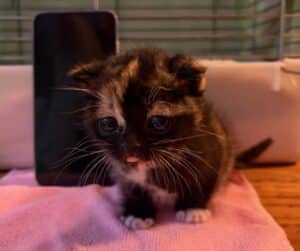
Her social media presence also offers an approachable way for people to learn about a rare feline condition. Instead of encountering pituitary dwarfism only through complicated medical terminology, followers get to know a real kitten living with it. They can watch Maeve play with her enormous canine brother, listen to her purr, and see how her family adapts to her individual needs.
The tiny kitten found beside a road has already come an extraordinary distance. At roughly 200 grams, sick, flea-covered, and alone in brutal weather, Maeve needed someone simply to notice her and give her a chance. Now she has warmth, medical care, a family devoted to understanding her needs, and thousands of people cheering on every wonderfully wobbly adventure.
Nobody can say exactly how much Maeve Maureen will eventually grow, and that uncertainty is part of the journey her family continues to document. Judging by the enormous personality already packed inside that tiny body, however, Maeve hardly needs to get any bigger to leave a very big impression.
View this post on Instagram
This content was created with AI assistance and edited by the iHeartCats team.