
After 25 years of rescuing cats, the team at Feline Lifeline thought they had encountered just about every feline configuration imaginable. Thousands of cats had crossed their path over the years, but somehow, one remarkably rare type had always remained missing from the list.
They had never encountered a male tortoiseshell or calico cat. The rescuers knew these cats existed, at least statistically, but actually meeting one seemed about as likely as stumbling across something out of a movie.
Then came Meo, an approximately one-year-old cat who had survived on the streets of Gardena, California, before making his way into rescue. With his colorful coat, affectionate personality, and highly unusual genetics, Meo quickly became something of a celebrity among people who had waited a quarter-century to meet a cat like him.
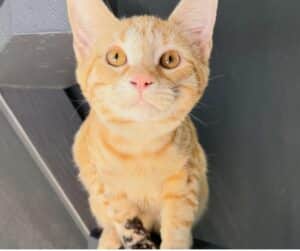
Feline Lifeline decided an ordinary name simply wouldn’t do. They named him Meo, a playful nod to Neo, the seemingly impossible exception at the center of The Matrix.
For the rescuers, the reference couldn’t have been more appropriate. After all those years of hearing that male calicos existed without ever encountering one themselves, their own version of “The One” had finally appeared.
After 25 Years, Rescuers Finally Meet ‘The One’
Male calico and tortoiseshell cats aren’t completely unheard of, but encountering one is exceptionally unusual. Feline Lifeline estimates that only about one in every 3,000 tortoiseshell or calico cats is male.
That made Meo a genuine first for a rescue that has spent decades working with cats. As Feline Lifeline joked, male torties and calicos had previously occupied roughly the same category as “competent bureaucracy and affordable veterinary medicine,” things they had been assured existed despite considerable evidence to the contrary.
Meo finally provided the evidence they needed. After thousands of cats and 25 years of rescue, the Matrix had apparently malfunctioned in their favor.
Why Are Male Calico Cats So Rare?
The reason cats like Meo are so unusual comes down largely to genetics. The genes responsible for the orange and black coat colors that create tortoiseshell and calico patterns are associated with the X chromosome.
Female cats typically have two X chromosomes, which makes it possible for them to inherit different color information on each one. Through a process called X-chromosome inactivation, different cells express one X chromosome or the other, helping create the distinctive patches of orange and black fur associated with tortoiseshell and calico coats.
Male cats typically have one X and one Y chromosome, so they ordinarily don’t have the two X chromosomes needed to produce that patchwork of orange and black. Rare genetic variations can result in a male cat having an extra X chromosome, often an XXY configuration, allowing a tortoiseshell or calico coat to appear.
Not every rare male calico necessarily has the same underlying genetic explanation, so Meo’s exact chromosomes cannot be determined simply by looking at him. What his coat can tell everyone, however, is that this handsome young cat belongs to a very uncommon group.
Meo Has One Particularly Excellent Detail
Meo would be memorable even if his unusual genetics were the end of the story. His coat, however, comes with an extra flourish that his rescuers couldn’t resist pointing out.

A smattering of black fur climbs up his right front leg, giving the already unusual cat one more distinctive feature. Feline Lifeline joked that it looks as though whoever was “rendering him” realized at the last minute that an improbable cat could stand to be slightly more ridiculous.
At approximately one year old, Meo is certainly handsome enough to attract attention. Yet the rescue says the cat underneath that extraordinary coat may be even better than the genetics that made everyone stop and stare.
Personal Space Doesn’t Mean Much to Meo
Meo is described as exceedingly affectionate, socially confident, and deeply interested in human companionship. This isn’t a cat who plans to sit quietly across the room and allow everyone to admire his rare coat from a respectable distance.
Instead, Meo wants to be close to his people. His rescuers joke that he regards personal space less as a boundary and more as an unfortunate misconception waiting for him to correct.
That affectionate personality is especially sweet considering that Meo previously survived on the streets of Gardena. Whatever his life looked like before rescue, he now appears quite ready to trade life outside for plenty of human attention.
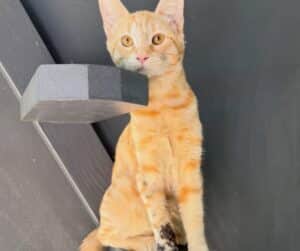
His unusual appearance may be what first gets people talking, but Meo doesn’t know that his chromosomes have made him a celebrity. As far as he’s concerned, there are humans nearby, and those humans could clearly be spending more time paying attention to him.
There Is Only One Meo
After 25 years and thousands of rescued cats, Feline Lifeline finally encountered an animal its team had previously known mostly as a statistical possibility. Meo arrived with the coat to make him extraordinary and the personality to make sure nobody forgets him.
His rescuers summed up their remarkable new arrival with another fitting nod to the movie that inspired his name. There may be a lot of cats in the Matrix, but there is only one Meo.
For this affectionate former street cat, being “The One” might be less important than what comes next. Meo has already beaten some remarkable genetic odds, and now he seems perfectly content to concentrate on the much more important business of getting as close to his humans as possible.