
Liv arrived at the shelter with a face that was impossible to forget, but there was much more behind her unusual expression than anyone could see at first glance. The 6-year-old domestic shorthair had been living as a stray before coming into the care of the Butler County Humane Society, where her noticeably different mouth immediately caught people’s attention. Her finder had even given her the memorable nickname “Zombie Cat” because of the condition of her face. Despite that dramatic introduction, Liv was simply a cat dealing with an uncomfortable medical issue and trying to adjust to a completely new environment.
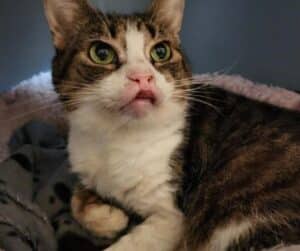
Liv was taken in by the Butler County Humane Society on March 26, 2026. After spending time surviving as a stray, suddenly finding herself surrounded by unfamiliar people, sounds, smells, and routines was another major change for her.
Shelter staff soon learned that the distinctive appearance around Liv’s mouth was connected to several rodent ulcers. Despite what their name might suggest, rodent ulcers are not caused by rodents, and Liv’s condition was not contagious.
The ulcers had affected her lips enough to give her the unique expression that inspired her nickname. More importantly, the condition was uncomfortable, which may have helped explain why Liv seemed somewhat grumpy during her early days in care.
For an animal unable to explain that something hurts, behavior can sometimes be one of the clearest ways to communicate discomfort. Liv needed more than people willing to look beyond her appearance. She needed time to feel better and an environment where she could begin relaxing.
What Are Rodent Ulcers in Cats?
Despite the unsettling name, rodent ulcers in cats have nothing to do with rodents. Also called eosinophilic ulcers, these lesions typically develop around a cat’s upper lip and are considered one form of feline eosinophilic granuloma complex, a group of inflammatory skin conditions.
The underlying trigger can vary from cat to cat. Allergies or hypersensitivity reactions, including reactions associated with fleas, food, or environmental allergens, may play a role, which is why determining the appropriate treatment can require veterinary evaluation rather than simply treating the visible sore.
Rodent ulcers are not contagious, so a cat cannot pass them to another cat or to a person. Depending on their location and severity, however, the lesions can cause irritation or discomfort and may require treatment along with management of any underlying trigger.
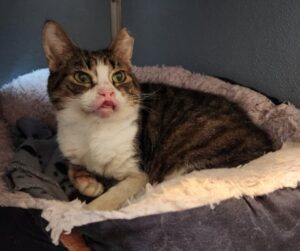
In Liv’s case, the ulcers dramatically changed the appearance of her lips and contributed to the unforgettable face that earned her the nickname “Zombie Cat.” Once she began to feel better, shelter staff started to see that the supposedly grumpy zombie had a much sweeter personality beneath the surface.
Liv Begins Showing Her Sweet Side
As Liv received care and started feeling more comfortable, shelter staff began noticing another side of her personality. The cat who had initially seemed unhappy and guarded slowly started showing that there was a sweet companion underneath that serious expression.
Feeling better gave Liv an opportunity to settle into her surroundings and become more comfortable with the people caring for her. Her transformation was not about changing the face that made her unique. Instead, it was about allowing her personality to emerge once discomfort was no longer overshadowing everything else.
The nickname “Zombie Cat” may have captured people’s attention at first, but it hardly describes the cat Liv is becoming. Her distinctive lips and unforgettable smile are only one small part of a much bigger personality. Now, shelter staff describe Liv as turning into a “sweetie pie.” It is a simple description, but one that shows just how much can change when an animal receives patience, understanding, and appropriate care.
Liv’s story is also a reminder that a frightened, uncomfortable, or seemingly grumpy shelter animal may be dealing with something people cannot immediately see. Sometimes the personality that appears during an animal’s hardest days is not the personality that eventually shines through once they feel safe and comfortable.
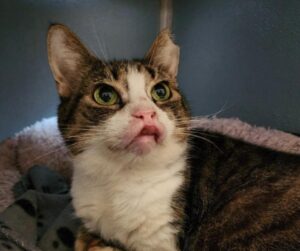
For Liv, that sweeter side has begun to reveal itself. The little stray who arrived with an unusual face and an unforgettable nickname now has the chance to be recognized for something far more important than her appearance.
Liv remains at the Butler County Humane Society in Renfrew, Pennsylvania. Her one-of-a-kind smile might be what first makes people stop and notice her, but the gentle personality emerging behind that smile may ultimately be what they remember most.