
Some cats quietly settle into a new home, but Leo arrived with plenty to say. His constant meowing had once been considered too much, even prompting his previous family to rehome him. When Leo eventually found his way to his new cat mom, Rosh, however, the very trait that had made life difficult for him became something worth celebrating. Instead of asking him to be quieter, she listened. Before long, those endless conversations turned into something unexpectedly beautiful as Leo discovered that his new human was more than willing to sing right along with him.

Their unusual bond captured hearts online after Rosh shared a video of the pair singing together. The sweet duet attracted more than a million likes, but the story behind Leo’s voice makes the moment even more touching.
Cats can respond to music in surprising ways. Research published in the Journal of Feline Medicine and Surgery in 2019 found that cats appeared less stressed when listening to music specifically designed for their species. These compositions often incorporate frequencies and rhythms inspired by feline vocalizations. For Leo, though, his favorite musical experience seems to involve something even more personal: singing with the person who gave his voice a place to belong.
Leo Finally Found Someone Who Loved His Voice
Before meeting Rosh, Leo had already experienced the uncertainty of losing a home. According to GeoBeats Animals, his previous humans ultimately rehomed him because he was so talkative. Despite that major change, Leo appeared surprisingly comfortable when he first arrived with Rosh. His personality quickly emerged, along with a steady stream of meows that did not stop simply because bedtime arrived.
Rosh soon discovered that Leo was especially vocal between midnight and three in the morning. At first, the nighttime conversations left her wondering whether something might be wrong.
“It kind of made me wonder if he was okay. But he actually was; he just really meowed a lot,” Rosh told GeoBeats Animals.
Once she understood that talking was simply part of Leo’s personality, Rosh began adjusting to life with her expressive companion. She even started waking around five in the morning, helping her schedule line up a little better with his. Then she discovered something that transformed all those meows into a shared activity.
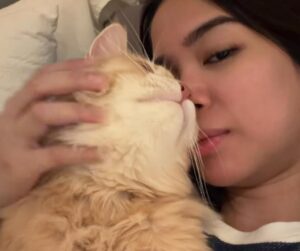
Rosh loves to sing, and Leo apparently has musical ambitions of his own. When she sings, her vocal cat joins the performance, answering her with perfectly timed meows and creating their own adorable duets.
Instead of seeing his voice as something inconvenient, Rosh found a way to connect with him through it. For a cat once rehomed partly because of how much he talked, that acceptance makes their musical moments especially meaningful. Leo did not have to become quieter to fit into his new family. He simply needed someone who understood that his voice was part of who he was.
Why Some Cats Have So Much to Say
Leo’s constant chatter might seem unusual, but meowing is one of the primary ways domestic cats communicate with humans. A vocal cat may be asking for attention, food, playtime or simply a little company. Some cats also seem naturally inclined to carry on conversations with their humans. When their person speaks, they respond with chirps, trills and meows, creating exchanges that can feel surprisingly interactive.
Timing can play a role as well. Cats are generally considered crepuscular, meaning they tend to be particularly active around dawn and dusk rather than being strictly nocturnal. That natural rhythm may help explain why some cats become especially energetic or vocal during hours when their humans would rather be sleeping.
Breed can sometimes influence vocal tendencies. Siamese cats are famously expressive, while Bengals and Sphynx cats are also known for being communicative. Other breeds, including the Chartreux, have reputations for being quieter.
Breed alone cannot predict how talkative an individual cat will be. Personality, environment, routine, and the cat’s relationship with people can all influence how frequently those meows fill the house. A sudden change in vocal behavior deserves more attention. If a normally quiet cat unexpectedly begins meowing frequently, particularly alongside changes in appetite, weight, mobility or behavior, speaking with a veterinarian can help determine whether discomfort or another health concern may be involved.

For cats like Leo, however, talking can simply be part of their personality. What one household finds overwhelming might become another person’s favorite sound. Leo’s story beautifully demonstrates that difference. The voice that once made finding the right home more difficult ultimately helped create a remarkable connection with Rosh. Now, when Rosh begins to sing, Leo does not have to hold anything back. He has an audience, a duet partner, and, most importantly, a home where every one of his meows is welcome.