
Cats attack feet and ankles because of predatory play drive, not aggression. Moving feet, especially under blankets or passing quickly in a hallway, trigger the same stalk-and-pounce instinct cats use on real prey. This is most common in kittens and young cats under two years old, in homes with no other cats to play-fight with, and in cats that aren’t getting enough daily active play.
It’s rarely a sign your cat dislikes you. It’s a sign they need more structured predatory outlets.
Evidence-reviewed, not hands-on tested.
Why Your Cat’s Brain Is Still Wired to Hunt
Domestication changed a lot about cats, but it barely touched this part of their wiring. Unlike dogs, who evolved alongside humans for thousands of years, house cats are genetically very close to their wild ancestors. Stalking and chasing aren’t a quirky personality trait.
They’re a drive built into the brain, separate from hunger, and researchers have documented this since the 1970s. Current feline behavior guidelines confirm the same thing: predatory play is a biological need, not a bad habit. Breeds known for an especially strong prey drive, covered in this breakdown of cat breeds with remarkable hunting skills, show just how deep this instinct runs even in cats that have never seen a mouse.
Your Hallway Is Your Cat’s Watering Hole
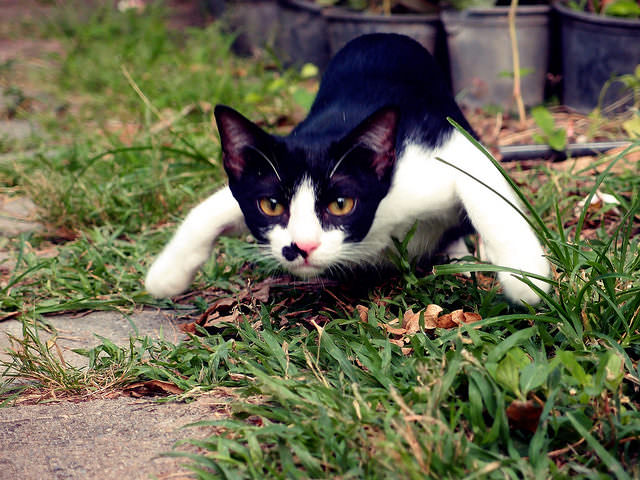
Wild cats pick ambush points where prey reliably passes by. Lions wait near watering holes. Leopards stretch out on branches above game trails.
Your cat runs the exact same math, just with different scenery. The hallway you walk through every morning, the gap under the couch, the shadow at the bottom of the stairs: these are your cat’s version of a watering hole. Your feet, moving at a predictable time and pace, are the easiest prey animal in the house.
That’s also why ambushes happen so often under the covers at night. A lump moving under a blanket looks and sounds exactly like a small animal rustling through grass. Your cat isn’t planning an attack out of spite. It’s running a script that’s older than the couch, the blanket, and probably the house.
Who’s Most Likely to Ambush Your Feet?
Not every cat turns your ankles into a chew toy, and there’s a pattern to which ones do. Cornell’s Feline Health Center notes that play aggression, including ankle-attacking and pouncing on moving feet, shows up most often in kittens and cats under two years old who are still refining their bite inhibition and hunting technique. Older cats usually grow out of the worst of it, though the instinct never fully disappears.
Household makeup matters too. The ASPCA points out that cats in single-cat homes are more likely to redirect play-aggression onto their humans, simply because they don’t have a littermate or housemate cat to wrestle and bite instead. If your cat is an only cat and under-stimulated, your legs are the next best thing.
Common Triggers and How to Stop Them
Here’s a quick way to match what’s happening to what actually works.
When Ankle-Attacking Crosses Into a Vet Visit
Most foot-ambushing is harmless, even when it draws blood through a sock. But watch for changes. Did a cat who’s always been a gentle pouncer suddenly start biting hard enough to break skin?
Is the attacking happening alongside hissing, dilated pupils, or a flicking tail that looks more defensive than playful? VCA Hospitals describes this pattern as redirected aggression, often triggered by pain, a startling noise, or stress the cat can’t otherwise release, and it’s different from normal play drive. If the behavior changes suddenly or escalates in intensity, a vet visit is the right next step, not more redirection toys.
How to Redirect the Behavior
You don’t have to live with ambushed ankles. You just have to give that hunting drive somewhere else to go.
- Fishing-pole or wand toys let your cat stalk, chase, and catch something that isn’t your leg.
- Food-dispensing balls and puzzle feeders turn a few minutes of your cat’s day into a full hunting sequence, from stalk to pounce to reward. Check out a roundup of the best cat puzzle toys if you want to build a rotation.
- A short, structured play session before bed can take the edge off nighttime ambushes.
- Keep a toy within reach for the moments you can’t play on demand, like when you’re trying to walk through the kitchen.
Think about it this way: a cat who’s had a real hunting session, stalk, chase, catch, and a reward at the end, has a lot less reason to turn your socks into prey. So, if you’ve been dealing with this for months, how much actual daily play has your cat gotten this week? Be honest. For a lot of cats, the answer is not much, and that gap is exactly what’s landing on your ankles.