
Cats can’t smile the way humans do, since their facial muscles aren’t built for it, but a kitten’s relaxed, half-closed eyes, soft mouth, and tilted head can look exactly like a smile to us, and that’s not an accident of our imagination. Researchers call this the ‘baby schema’ (Kindchenschema), a set of infant-like features, like big eyes, a rounded face, and soft curves, that evolutionary biologist Konrad Lorenz first described in 1943 as triggering automatic caregiving responses in humans. When a kitten’s face hits those proportions, our brains respond with the same reward and bonding chemistry activated by human infants, which is part of why a single ‘smiling kitten’ photo can rack up millions of shares in a day.
This explainer is evidence-reviewed, not hands-on tested.
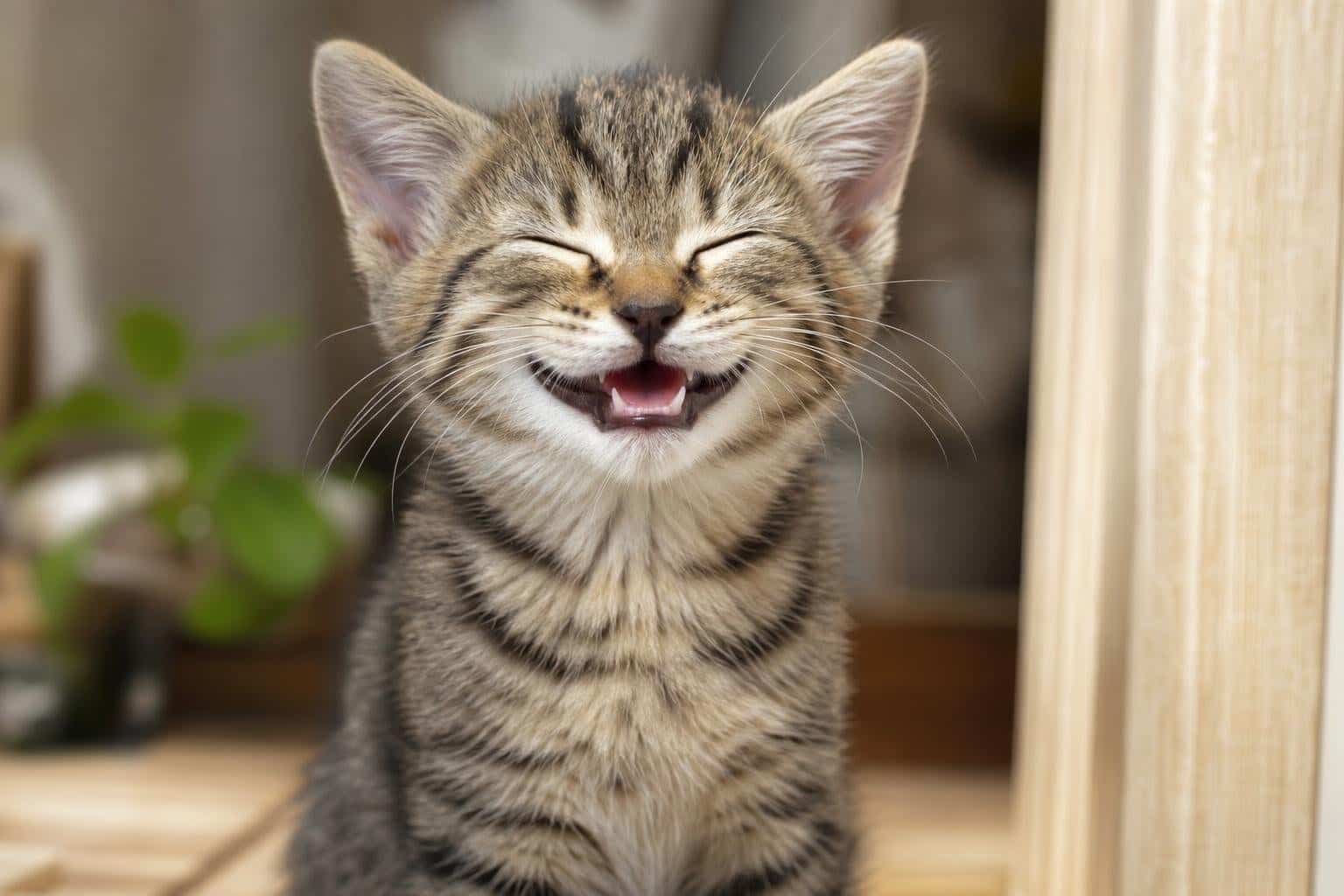
This charming photograph showcases a tabby kitten displaying what looks like a genuine smile, creating an irresistible mix of innocence and joy. The image shows how feline expressions can mirror human emotions, giving viewers an instant dose of happiness that brightens even the gloomiest days.
Why do kittens look like they’re smiling?
Cats don’t have the facial muscles for a human-style smile. Veterinary behavior researchers who study feline facial movement, including the team behind the Cat Facial Action Coding System, have mapped the specific muscle movements cats can make, and a true ‘smile’ isn’t one of them (Caeiro, Burrows & Waller, 2017). What you’re reading as a grin is really a cluster of relaxed signals: half-closed eyes, a loose jaw, and a soft, forward-tilted head. Put those same features on anything, kitten or human baby, and they trigger what evolutionary biologist Konrad Lorenz named the ‘baby schema’ (Kindchenschema) back in 1943, a set of infant-like proportions that reliably triggers caregiving instincts in adult brains.
Modern neuroscience backs this up. Kringelbach and colleagues (2016) found that cute, baby-schema features activate reward regions of the brain tied to dopamine release within a fraction of a second of viewing them, faster than most conscious thought. Research on human-animal bonding has also measured real spikes in oxytocin during positive interactions with animals (Odendaal & Meintjes, 2003), the same hormone tied to parent-infant bonding. So when a kitten’s face lines up with those proportions, your brain gives you a quick, involuntary hit of its own feel-good chemistry, which is part of why a single ‘smiling’ kitten photo can rack up shares so fast.
Photography plays into this too. Natural light on the whiskers, bright catchlights in the eyes, and a slightly tilted head all read as playful to a human viewer, even though the cat is likely just relaxed or curious. Those technical choices don’t change what the cat feels, they just change how convincingly we read a feeling onto its face. The same bonding response shows up in other everyday cat behaviors, like touching noses with you as a sign of trust.
What makes a kitten photo go viral?
Researchers who study why people watch cat content online have found it does something measurable: in a 2015 study published in Computers in Human Behavior, viewers reported more energy and more positive emotions after watching cat videos, even when they felt a little guilty about procrastinating to watch them (Myrick, 2015). That emotional payoff is a big part of why a well-timed kitten photo spreads so fast. A few things tend to show up together in the images that travel the farthest:
- Expressive facial features that suggest human-like emotions
- Soft textures and warm colors that create visual comfort
- Perfect timing capturing a fleeting moment of apparent joy
- Composition that draws viewers directly to the cat’s face
Professional animal photographers lean into these patterns on purpose. They wait for the moment a cat’s expression relaxes, since that’s what reads as contentment through a camera lens. Soft-coated breeds tend to photograph especially well under this kind of natural light, which is part of why they show up so often in viral posts.
The viral power of heartwarming animal moments
Digital platforms have transformed how we share and consume emotionally resonant content. This smiling kitten photograph demonstrates the viral potential of images that evoke immediate positive responses. Within hours of initial posting, such content can reach millions of viewers across continents.
Authenticity seems to matter more than production value. Viewers can usually tell the difference between a cat that’s genuinely relaxed and one that’s been posed or forced into a cute position, and that difference often decides whether a photo gets shared by thousands of people or scrolled straight past.
Animal welfare and adoption groups use this same kind of photo on purpose, since a kitten that reads as happy and relaxed tends to draw more attention to an adoption listing than a flat, posed shot does.
The lasting impact of this charming feline portrait extends far beyond momentary amusement. It represents our fundamental need for joy, connection, and the simple pleasure found in witnessing pure contentment. Such images remind us that happiness often exists in the smallest, most unexpected moments, like the quiet routines in signs your cat thinks they’re your guardian angel.