
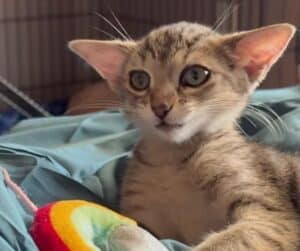
One glance at HERBIE is enough to notice that this special cat looks a little different, but it is his affectionate personality that truly makes him unforgettable. With his distinctive face, expressive eyes, and ears that sit differently from those of most cats, HERBIE quickly captured attention online.
Behind his unusual appearance are two neurological conditions: bilateral facial nerve paralysis and cerebellar hypoplasia. Neither has stopped HERBIE from building a happy life with his mom, Paige, who first welcomed him as a foster and quickly realized he was exactly where he belonged.
HERBIE Blinks a Little Differently
HERBIE’s bilateral facial nerve paralysis affects movement on both sides of his face. Facial nerve paralysis can interfere with normal facial movements in cats, including the ability to blink normally, which helps explain one of HERBIE’s most noticeable quirks.
HERBIE doesn’t blink by closing his outer eyelids the way most cats do. Instead, Paige explains that he blinks with his third eyelids, also known as the nictitating membranes, which are protective membranes located near the inner corners of a cat’s eyes.
Because HERBIE can’t blink normally, Paige gives his eyes some extra attention as part of his routine. She gently wipes around his eyelids to help keep the area clean and watches out for anything that might need additional care.
According to Paige, HERBIE’s condition does not cause him pain, and he doesn’t require daily medication for it. It’s simply part of how his body works, and Paige has learned the small adjustments that help keep him comfortable.
His Wobbles Have a Name Too
HERBIE’s other neurological condition is cerebellar hypoplasia, often shortened to CH. The condition occurs when the cerebellum, the part of the brain responsible for coordinating movement and balance, doesn’t develop completely.
That’s why cats with CH can wobble, tremble, or move with an unsteady gait even when they know exactly where they want to go. The condition isn’t progressive, meaning it doesn’t continually worsen over time, and many cats with CH learn to navigate their surroundings remarkably well with a few accommodations.
HERBIE experiences mild wobbles and tremors, but he has become quite skilled at getting around. He doesn’t regularly bump into things and has figured out how to navigate his familiar surroundings in his own way.
Mealtime looks a little different for him, too. Rather than eating like most cats, HERBIE tends to peck at his food, so Paige provides an elevated bowl that gives him a more comfortable position while he eats.
Those accommodations aren’t particularly complicated, but they make a meaningful difference for HERBIE. Paige has simply learned how HERBIE experiences the world and built his routine around what works best for him.
HERBIE Found His Perfect Place
HERBIE’s journey with Paige began through fostering. She originally welcomed him into her home, intending to provide temporary care, but it took only about a week for that plan to change.
Once HERBIE felt safe enough to settle in, more of his personality began to emerge. Beneath the unusual expressions and wobbly steps was an incredibly social, affectionate, and wonderfully goofy cat who wanted to be close to Paige whenever possible.
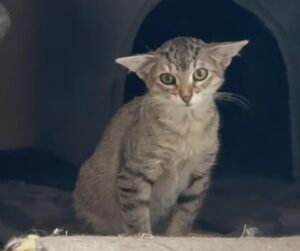
HERBIE loves cuddling and frequently insists on sitting in Paige’s lap. He’s also gentle around the other pets in the household, showing an easygoing temperament that has helped him fit comfortably into family life.
When excitement takes over, HERBIE has another memorable habit. He makes a distinctive chirping sound, especially when he’s excited or running around, and combined with his wobbles and playful personality, the little sound has become another endearing part of what makes him unmistakably HERBIE.
It didn’t take long for Paige to realize that her foster cat wasn’t going anywhere. What began as temporary care turned into a permanent home, making Paige a very happy “foster fail.”
HERBIE May Get to Help the Next Foster Kittens
Adopting HERBIE doesn’t mean Paige plans to stop fostering. She hopes to continue welcoming animals in need, which could eventually give HERBIE a new job of his own.
Because he’s gentle, friendly, and comfortable around other animals, HERBIE could become a reassuring companion for younger foster cats adjusting to unfamiliar surroundings. The shelter cat who once needed someone to understand what made him different may someday help another frightened cat discover what safety and companionship feel like.
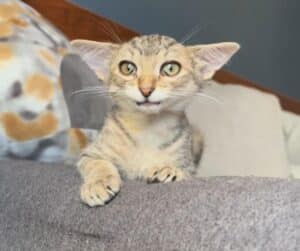
HERBIE’s unusual expressions and wobbly walk may be what first catch people’s attention, but they aren’t the most important things about him. He’s a cuddler, a chirper, a lap cat, and a goofy companion who happened to find a mom willing to learn exactly what he needed.
Paige didn’t need HERBIE to move, eat, or even blink like every other cat to see what made him special. She simply gave him the chance to be HERBIE, and it turns out HERBIE is pretty wonderful exactly as he is. Keep up with HERBIE @herbieblinks on Instagram!