
A strange little cat brought to a Bolivian wildlife sanctuary seemed unusual from the moment biologist Paola Nogales-Ascarrunz first saw it in 2017. With its compact face, rounded ears, long whiskers, and coat covered in bold leopard-like spots, the animal looked nothing like an ordinary housecat. Yet that was exactly what a local man had once believed it to be after finding the tiny kitten alone on a road near a forest. He brought it home and cared for it for about a year before realizing that the increasingly wild animal belonged somewhere better suited to its needs.
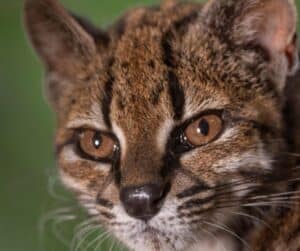
That realization eventually brought the cat to Senda Verde, a wildlife sanctuary on the subtropical slopes of the Bolivian Andes. Staff there contacted Nogales-Ascarrunz, a biologist, National Geographic Explorer, and founder of the Bolivian Felids Research Program. Intrigued by reports of the unusual animal, she traveled to the sanctuary to see it herself. The moment she encountered the spotted feline, she was captivated.
“I took a hundred pictures of it,” Nogales-Ascarrunz recalled. “I was so fascinated.”
She could not have known that those photographs would become part of a scientific mystery that would take years to unravel. According to research published in Current Biology, the mysterious feline would ultimately be proposed as a new species to science, Leopardus tilcayo.
A Photograph That Raised New Questions
At first, Nogales-Ascarrunz believed the animal belonged to Leopardus tigrinus, one of the small spotted wild cats commonly known as tiger cats, oncillas, tigrillos, or little spotted cats. Historically, these elusive felines were believed to occupy a broad range across Central and South America.
For a while, that identification seemed reasonable. The cat was small, secretive, and covered in the distinctive markings associated with tiger cats. Then, in 2019, Nogales-Ascarrunz was preparing a booklet about Bolivia’s wild cat species when something caught her attention. Comparing her photographs with a reference image of a tiger cat from neighboring Brazil, she noticed that the markings did not match. The Bolivian animal’s rosettes were noticeably larger.
“This is so wrong,” she remembered thinking.
That observation transformed an interesting encounter into a scientific puzzle. The differences might have appeared subtle to most people, but to researchers studying closely related species, details such as coat patterns, tail length, teeth, and body proportions can provide important clues. Still, appearances alone would not settle the question.
Nogales-Ascarrunz spent the following years developing her genetic analysis skills. She eventually worked with geneticist Eduardo Eizirik of the Pontifical Catholic University of Rio Grande do Sul in Brazil and study co-lead author Jonas Lescroart of the University of Antwerp.
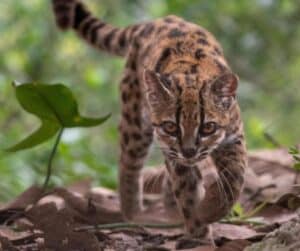
By examining genetic evidence, the researchers were able to place the mysterious Bolivian cat on the feline family tree. Their findings indicated that it was distinct enough to be proposed as its own species.
The team proposed the name Leopardus tilcayo, drawing from the traditional name used by people living in the region. Nogales-Ascarrunz asked locals why they called the animal “tilcayo,” but there appeared to be no simple explanation. The name had simply been passed down through generations.
So far, researchers have identified the species in Bolivia’s Yungas forest ecoregion, a lush landscape stretching along the eastern slopes of the Andes. Much about the animal remains unknown, including its diet, reproductive behavior, ecological relationships, and everyday habits.
“So many basic things are not known,” Nogales-Ascarrunz said.
That mystery is partly what makes the discovery so significant. Small wild cats can be remarkably difficult to study. They often inhabit dense environments, avoid people, and can resemble closely related species so strongly that even photographs from trail cameras may not reveal their true identities.
Genetic analysis is helping researchers see differences that appearances alone can hide. Scientists have already discovered surprising diversity among tiger cats. In 2013, research indicated that animals previously grouped under Leopardus tigrinus represented two distinct species. Further research published in 2024 proposed another genetically distinct species. With L. tilcayo, the researchers’ latest work recognizes five tiger cat species.
“What we once thought to be a single species, we’ve started to see that it was actually a species complex,” Eizirik explained.
The findings also demonstrate how much remains unknown about the world’s smaller wild cats. Larger members of the cat family, including lions and tigers, have received considerably more scientific attention. Their smaller relatives can remain hidden in forests and mountains for generations, sometimes leaving scientists with only scattered photographs, museum specimens, or genetic samples to study.
Even museum collections can contain surprises. One specimen examined during the research had originally been identified as a margay, another small spotted wild cat. Researchers later recognized it as a tiger cat, in part because of the direction in which the hair on its neck grew.
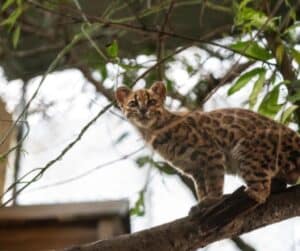
The discovery of Leopardus tilcayo, therefore, represents more than the addition of another name to the cat family. It shows how genetics can reveal biological diversity that has been hiding in plain sight and may help scientists better understand which populations require individual conservation attention. For Nogales-Ascarrunz, the discovery began with something much simpler: a phone call about a “weird cat,” followed by an unforgettable visit to a sanctuary.
Years later, the animal that once puzzled its caretakers has helped scientists see the feline family tree in an entirely new way. And somewhere within Bolivia’s misty Yungas forests, other tilcayos may still be moving quietly through the vegetation, carrying secrets researchers are only beginning to understand.
View this post on Instagram
This content was created with AI assistance and edited by the iHeartCats team.