
Some cats capture attention with their bright eyes or fluffy coats, but Meemers has something else that makes people stop and smile. The two and a half year old rescue cat from Bloomington, Illinois, has short spine syndrome, a rare condition that gives her an unusually compact body and virtually no visible neck. Her distinctive appearance has drawn comparisons to Jimothy the Raccoon and other beloved animals with similar conditions. Yet behind the millions of views and affectionate comments is a much more meaningful story about a cat who was once left in a box outside a shelter and eventually found exactly the person willing to understand what she needed.
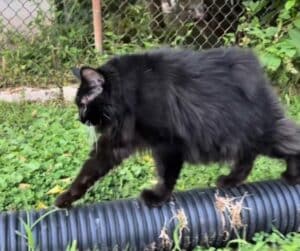
Meemers recently became an unexpected social media sensation after her owner, Katie Dahlen, shared a simple video of her. The clip showed the fluffy black cat doing little more than sitting comfortably and looking toward the camera, but her unmistakable appearance quickly captured people’s attention. Within days, the video had accumulated more than 41 million views.
Dahlen previously worked at the shelter where Meemers was found and had always enjoyed creating videos for social media. She thought her unusual and lovable cat might brighten people’s feeds, but she never anticipated such an enormous response.
“I missed making videos, and I was like, ‘Well, I have this awesome cat, and I want to share her with people,'” Dahlen told TODAY.com.
What followed surprised her. Meemers seemingly became an online celebrity within 24 hours, attracting people who were fascinated by her appearance and charmed by her calm confidence.
From a Box Outside to a Loving Home
Long before millions of people knew her name, Meemers arrived at a shelter under much sadder circumstances. Someone had left her outside the building in a box while Dahlen was working there. Dahlen immediately felt drawn to the little cat. Despite Meemers’ unusual body and uncertain past, she saw an animal who deserved comfort and security.
“Literally, from the day she came in, I was like, ‘She needs to come home with me,'” Dahlen recalled.
Meemers needed help before that could happen. Her fur around her rear was badly matted, and she also had an abscess there. There were signs that her previous owner had attempted to shave the affected fur. Dahlen believes the person may have cared about Meemers but lacked the resources to provide the treatment she needed. Whatever circumstances brought her to the shelter, Meemers was finally somewhere she could receive proper care.
She was treated with antibiotics and given plenty of attention while she recovered. Once she was healthy enough, she went home with Dahlen, beginning a completely different chapter of her life.
Dahlen and her husband have shared their home with Meemers since July 2025. Over that time, they have learned how to adapt everyday routines around her physical differences while allowing her personality to flourish.
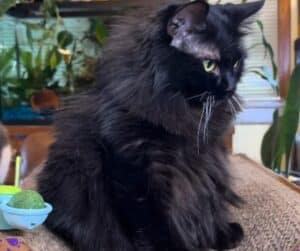
Meemers measures only about seven and a half inches from her shoulders to the base of her tail. She also has a slight tail deformity and cannot move quite like a typical cat. She does not climb very much and is unable to jump. Because her organs are contained within such a compact body, she also needs to be held carefully and comfortably.
Temperature is another consideration. Meemers can overheat easily, particularly when she becomes too active. Dahlen compares this sensitivity to what some flat-faced dog breeds experience in warm weather. If Meemers pushes herself too hard, she may begin panting, so her outdoor adventures are carefully supervised.
When she spends time in the backyard, Dahlen generally waits until the evening when temperatures are cooler. These small adjustments give Meemers opportunities to explore while keeping her comfortable.
Her short spine also makes grooming difficult. With virtually no neck, Meemers cannot properly reach much of her back on her own. Dahlen has happily taken over that responsibility. She brushes Meemers several times each day, often turning quiet evenings in front of the television into grooming sessions with the cat resting comfortably on her lap.
Occasional baths help keep her coat clean and healthy as well. What might sound like extra work has simply become part of the family’s normal routine.
None of Meemers’ physical limitations have kept her from embracing life. According to Dahlen, she is exceptionally social and genuinely enjoys meeting people. She can even accompany her family on outings while wearing a leash. Rather than hiding from attention, Meemers seems perfectly comfortable receiving it.
Affection often brings out another memorable part of her personality. When someone pets her, she responds with tiny conversational meows that Dahlen compares to Gary the snail from SpongeBob SquarePants.
“She loves to be held, but you have to hold her right,” Dahlen said. “When you pet her, she will talk.”
Even her unusual name has its own sweet history. Meemers was originally called Mila, which gradually became Mimi and then a collection of affectionate nicknames. Eventually, “Meemers” emerged and stuck. More importantly, the cat began responding to it, making the playful nickname effectively official.
Her sudden popularity has given Dahlen an opportunity to show people something more meaningful than an unusually shaped cat. Meemers is an example of how animals with special needs can enjoy rich, affectionate lives when their families are willing to make thoughtful accommodations.
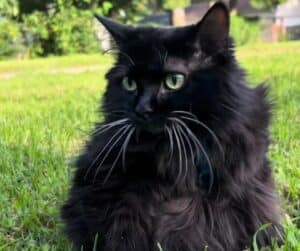
Her body may require different routines, but those differences have done little to diminish her curiosity, sociability or capacity for affection. The frightened and uncomfortable cat, once discovered outside a shelter, now spends her days being brushed, exploring safely, chatting with her humans, and charming millions of strangers online. For Dahlen, that transformation is also a reminder that special needs animals should not be overlooked simply because their care may look a little different.
“They definitely do require a little adaptation at home, but they are so worth it,” she said.