
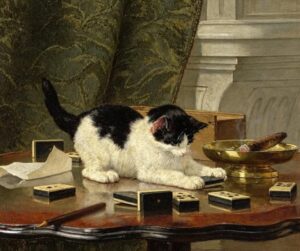
Long before cat videos filled social media, a Dutch painter was capturing the playful trouble that kittens could create inside a home. Henriëtte Ronner-Knip spent decades painting cats in the middle of their everyday adventures, from climbing furniture to knocking over household objects. Her paintings showed kittens exploring rooms, playing with things they probably shouldn’t touch, and turning peaceful surroundings into scenes of delightful chaos.
What makes her artwork especially charming is how familiar these moments still feel today. A kitten reaching toward an ink pot or scrambling across a piano could easily remind modern cat parents of their own curious companions. Although Ronner-Knip lived more than a century ago, her paintings captured the same playful behavior that continues to entertain cat lovers everywhere.
From Painting Street Dogs to Capturing Cats
Henriëtte Ronner-Knip was born on May 31, 1821, in Amsterdam, the Netherlands, into a family of artists. Her father, who was also a painter, introduced her to art at an early age and provided her first lessons.
Around 1850, she settled in Brussels, Belgium, where she began establishing herself as an accomplished animal painter. During her earlier career, she became particularly known for portraying the city’s street dogs.
Her talent eventually attracted the attention of European royalty. Among her notable commissions were portraits of royal lapdogs, including dogs belonging to Marie Henriette of Austria and Princess Marie of Hohenzollern-Sigmaringen.
But around 1870, her artistic interests began shifting toward another familiar companion. Cats were becoming increasingly fashionable household pets, and Ronner-Knip started dedicating much of her work to portraying them.
This change would become one of the defining features of her career. Rather than simply painting cats sitting quietly, she frequently depicted them exploring, playing, and getting themselves into amusing situations.
Every Kitten Seems Ready to Cause Trouble
One of the most entertaining qualities of Ronner-Knip’s paintings is the way she captured kittens surrounded by objects they could easily disturb. Some appear near overturned ink pots, while others climb onto pianos or become tangled among sheets of music.
In other scenes, bottles and objects are scattered across tables as curious kittens investigate their surroundings. The compositions often capture the moment when a small movement could create an even bigger mess.
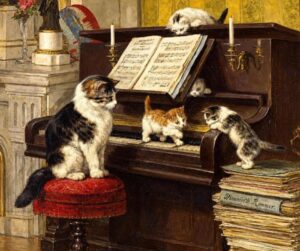
These scenes are filled with details that cat parents will recognize. Kittens investigate unfamiliar objects, reach toward interesting things, and turn ordinary furniture into opportunities for play.
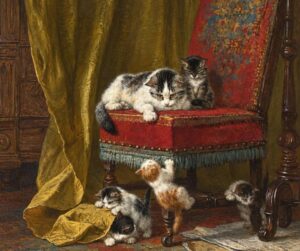
Ronner-Knip also portrayed quieter moments, showing cats sleeping or resting comfortably inside domestic spaces. Together, these paintings revealed different sides of feline life, from peaceful companionship to energetic curiosity.
Her distinctive artistic style helped bring these scenes to life. Using soft, feathery brushstrokes and warm colors, she gave her animal subjects expressive appearances while carefully portraying their fur, movements, and surroundings.
A Painter Who Understood the Charm of Cats
Ronner-Knip’s paintings belonged to the Romanticist tradition, which often emphasized emotion and expressive subjects. Her animal portraits reflected this approach through their warm atmosphere and attention to familiar domestic moments.
Rather than presenting every cat in a formal pose, she frequently allowed playful interactions to become the center of the composition. A kitten investigating a household object could be just as interesting as an elaborate portrait.
Her work also reflected the growing place of cats within European homes during the nineteenth century. As cats became increasingly popular companions, paintings featuring their playful behavior appealed to people who enjoyed seeing familiar animals represented in art.
Her Playful Kittens Still Have Admirers Today
Henriëtte Ronner-Knip died on February 28, 1909, in Ixelles, Belgium, after a long career devoted largely to animal painting. Her works are now held in private collections and museums, including the Rijksmuseum in Amsterdam and the National Gallery in London.
More than a century after her death, her paintings remain appealing because of their recognizable feline subjects. The furniture, clothing, and household objects may belong to another era, but the kittens behave in ways that still feel wonderfully familiar.
Whether they are climbing onto a piano, investigating an ink pot, or playing among scattered papers, Ronner-Knip’s kittens remind viewers that curious cats have been finding ways to entertain themselves for generations.
This content was created with AI assistance and edited by the iHeartCats team.