
Cats have some of the most beautiful and mysterious eyes in the animal kingdom, but every once in a while, a veterinarian encounters something that makes even experienced animal lovers look twice. That’s exactly what happened when Jarrettsville Vet Center shared a fascinating video of a black cat with an unusual feature inside its eye.
Rather than immediately explaining what made this feline so special, the veterinary team decided to turn the discovery into a little mystery for its Facebook followers. The clinic invited viewers to take a close look and guess what was happening inside the cat’s eye, calling its unusual patient the coolest kitty of the day. The answer turned out to be a little-known eye condition with a surprisingly interesting explanation.
A Black Cat With an Eye That Deserves a Closer Look
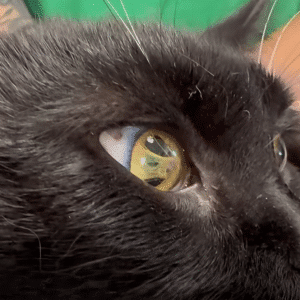
In the video shared by Jarrettsville Vet Center, a black cat takes center stage as the veterinary team draws attention to its unusual eye. The clinic asks viewers to examine what they’re seeing, offering no immediate explanation for the distinctive appearance.
Most cat lovers are familiar with the mesmerizing way feline pupils change shape depending on the light. In bright conditions, those pupils become narrow vertical slits, while in dimmer surroundings, they expand into large, dark openings that help cats see more effectively.
But this particular cat had something different going on. Instead of the usual uninterrupted appearance of the pupil, there was an unusual structure that prompted the veterinary team to challenge viewers to identify it.
The answer came when Jarrettsville Vet Center revealed the diagnosis in the comments: persistent pupillary membrane, or PPM. Although the name might sound intimidating, it’s a fascinating developmental condition that can sometimes give an animal’s eye a striking appearance. And for anyone who has never heard of PPM before, the explanation begins long before a kitten ever opens its eyes.
What Is Persistent Pupillary Membrane in Cats?
Persistent pupillary membrane is a congenital eye condition, meaning it develops before birth. It occurs when tiny strands of tissue that normally disappear as the eye develops remain attached to structures inside the eye.
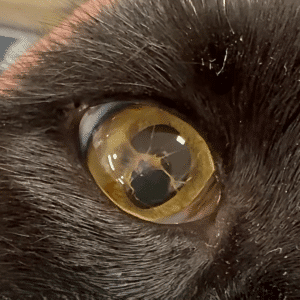
Before a kitten is born, a temporary network of blood vessels helps nourish the developing lens. This network, known as the pupillary membrane, normally regresses as the eye matures, leaving the pupil clear. Occasionally, parts of that temporary tissue remain behind. These remnants can appear as delicate strands, threads, or web-like structures extending across the pupil or connecting different areas inside the eye.
The strands typically originate from the iris, the colored portion of the eye surrounding the pupil. Depending on the individual animal, they may stretch between two points on the iris, attach to the lens, or connect to the inner surface of the cornea. In some cats, these membranes are so fine that they may go unnoticed without a detailed eye examination. In others, the strands create a distinctive pattern that becomes visible when someone looks closely.
Persistent pupillary membranes are considered uncommon in cats, making this black feline’s unusual eye an especially interesting veterinary find. And while the condition may look mysterious, it doesn’t necessarily mean the cat is experiencing discomfort or vision problems.
Can Cats With Persistent Pupillary Membranes See Normally?
One of the first questions people might have after seeing this unusual eye is whether the cat can see properly. Fortunately, many animals with mild persistent pupillary membranes have normal or nearly normal vision.
The effect on eyesight depends largely on where the remaining tissue is located and how much of the eye it affects. Small strands connecting different parts of the iris often cause little trouble, especially when they don’t interfere with light entering the pupil.
However, membranes that attach to the lens or cornea can sometimes create additional complications. Certain attachments may be associated with cloudiness, localized corneal changes, or lens opacities that can affect vision.
A veterinary ophthalmologist can examine these structures using specialized equipment to determine whether the condition is simply an unusual anatomical feature or something requiring closer monitoring. The examination also helps distinguish PPM from other conditions that may produce a similar appearance.
For the black cat featured by Jarrettsville Vet Center, the Facebook post identifies the condition but doesn’t provide details about the animal’s vision or whether any treatment was recommended. The unusual appearance alone isn’t enough to determine whether this particular cat experiences any visual difficulties.
Does Persistent Pupillary Membrane Require Treatment?
The good news is that many cats with persistent pupillary membranes don’t require treatment at all. When the remaining strands are small and aren’t affecting vision or eye health, veterinarians may simply recommend monitoring the condition during routine examinations.
Because PPM develops before birth, it isn’t something a cat suddenly catches from another animal or develops through ordinary exposure to the environment. The membranes are remnants of normal fetal development rather than an infection or contagious disease.
In more complicated cases, a veterinary ophthalmologist may recommend additional evaluation, particularly when the membranes are associated with corneal cloudiness, lens changes, or other eye abnormalities. Treatment decisions depend on the individual animal and the specific structures involved.
It’s also important for cat parents to recognize when an eye problem needs veterinary attention. Squinting, redness, excessive tearing, discharge, cloudiness, or sudden changes in vision should always be evaluated rather than assumed to be harmless.
Although persistent pupillary membranes are often benign, not every unusual-looking eye has the same explanation. That’s why professional examination is so important whenever a cat develops a new or concerning eye change.
The Fascinating Things Veterinarians Discover Every Day
One of the most interesting aspects of veterinary medicine is the sheer variety of things professionals encounter. Even after years of examining animals, veterinarians can still come across unusual anatomical features, rare conditions, and unexpected findings that make an ordinary appointment memorable.
Some cats have extra toes, while others are born with unusual ear shapes, distinctive coat patterns, or differences in their eyes. Certain features are simply harmless variations, while others offer important clues about an animal’s health.
Veterinary professionals are trained to recognize the difference, often noticing subtle details that might escape the average pet parent’s attention. An eye that looks unusual to someone at home can reveal an entirely different story when examined with the right equipment.
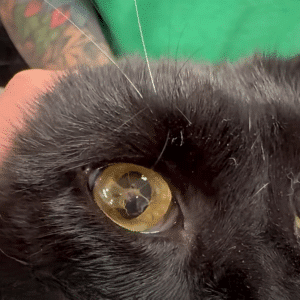
Persistent pupillary membrane is a particularly fascinating example because it offers a glimpse into how an animal develops before birth. Those tiny strands are essentially remnants of a temporary structure that once played a role in the developing eye.
And while most people will never need to identify a persistent pupillary membrane themselves, learning about the condition can help them appreciate just how intricate feline eyes really are. It’s also a reminder that unusual features aren’t always signs of illness, although a veterinarian should always evaluate new or concerning changes.
This Black Cat Turned an Eye Examination Into a Veterinary Mystery
By sharing this black cat’s unusual eye, Jarrettsville Vet Center transformed a fascinating veterinary finding into an opportunity for people to learn something new. Instead of simply announcing the diagnosis, the team encouraged viewers to look closely and think about what they were seeing.
The clinic’s playful approach made a complicated medical term feel much more approachable. It also gave a memorable feline patient a chance to show off a feature that most cat lovers have probably never encountered.
For anyone wondering what PPM looks like in a real cat, the original video offers an opportunity to examine the unusual eye for themselves. The strands may be small, but the developmental story behind them is remarkably complex.
Sometimes, the most fascinating veterinary discoveries aren’t dramatic emergencies or complicated procedures. They’re the quiet little details that reveal how extraordinary an animal’s body can be. And thanks to one beautiful black cat and a curious veterinary team, there’s now another interesting term for cat lovers to remember. Persistent pupillary membrane may be a mouthful, but it’s also a wonderful example of the unexpected things veterinarians see every day.
Watch the original video from Jarrettsville Vet Center below and take a closer look at this remarkable feline’s eye. Once you know what you’re looking for, you might find yourself just as fascinated as the veterinary team.
This content was created with AI assistance and edited by the iHeartCats team.