
You can make safe, vet-conscious cat treats at home in under 30 minutes using simple ingredients like cooked chicken, tuna, catnip, honey, or whole wheat flour, with no artificial preservatives required. Below are 5 easy DIY cat treat recipes, each with full ingredients, step-by-step instructions, and bake times, plus the safety rules on what to avoid and how much to feed that apply to every one of them. Treats should never exceed about 10% of a cat’s daily calories, per general veterinary feeding guidance.
Evidence-reviewed, not hands-on tested. We pulled the nutrition and safety claims below from veterinary and public health sources, dated so you can check them yourself, rather than testing every batch in our own kitchen.
Why bother making your own? Homemade versions let you control exactly what goes into your cat’s bowl, down to each ingredient.
Curious which recipe fits your cat best? The table below breaks down all 5 at a glance before you commit to a grocery list.

Quick Comparison: 5 DIY Cat Treat Recipes
Cooking for Cats Safety Tips
Before you preheat the oven, run through these basics. They apply to all 5 recipes below, not just one of them.
- Understand feline nutrition. Cats are obligate carnivores and need animal protein as the backbone of their diet, according to the Cornell Feline Health Center (reviewed 2021). Talk to your vet before making any big change to what your cat eats.
- Avoid toxic foods. Onions, garlic, chocolate, grapes, raisins, caffeine, alcohol, and xylitol are all dangerous for cats, per the ASPCA Animal Poison Control Center (2023). Double-check every ingredient before it goes in the mixing bowl.
- Cook meat thoroughly. Raw meat carries salmonella and E. coli risks for cats and for whoever’s handling it in the kitchen, according to the FDA (2022). Skip oils, butter, and seasoning too; your cat doesn’t need them and some aren’t safe.
- Keep it a supplement, not a meal. Homemade treats aren’t a substitute for a complete, balanced commercial cat food. Think of them as an extra, not the main event.
- Watch the portions. The WSAVA Global Nutrition Committee recommends treats stay under roughly 10% of a cat’s daily calories (WSAVA, 2021). If your cat tends to make a mess chasing crumbs around the bowl, smaller training-sized pieces also help with portion control; our guide on messy eaters covers more feeding adjustments.
- Watch for allergies. Introduce any new treat gradually and watch for itching, digestive upset, or respiratory signs.
- Skip bones and hard chunks. Cooked bones splinter easily. Keep pieces small to prevent choking.
- Hydration still matters. These treats are dry and low-moisture, so don’t forget water intake on treat days. Our piece on adding water to your cat’s kibble covers ways to boost moisture in a dry-food routine.
Every cat is different, isn’t that always the case? Watch how yours reacts to a new treat before making it a regular thing.
5 Easy DIY Cat Treat Recipes
Here’s the thing: you don’t need fancy equipment for any of these. A bowl, a baking sheet, and an oven will get you through all 5.
Recipe 1: Chewy Chicken Treats (inspired by Joy the Baker)

This one’s adapted from a chewy cat treat recipe Joy Wilson originally shared on Joy the Baker. It’s a simple chicken treat recipe that works as an everyday reward.
Ingredients:
- 1 cooked boneless chicken breast, shredded (about 1 cup)
- 1/4 cup plain chicken broth, no onion or garlic added
- 1 cup whole wheat flour (swap in oat flour for a grain-free version)
- 1 egg
Instructions:
- Preheat your oven to 350°F (175°C) and line a baking sheet with parchment paper.
- Pulse the shredded chicken and broth in a food processor until finely chopped.
- Add the flour and egg, then mix until a thick dough forms.
- Roll the dough to about 1/4 inch thick on a floured surface.
- Cut into small, bite-sized shapes.
- Bake for 20 to 25 minutes, until firm and lightly golden at the edges.
- Cool completely on a wire rack before serving.
Give one or two pieces a day, depending on your cat’s size.
Recipe 2: Tuna and Catnip Croutons (inspired by The Cookie Rookie)
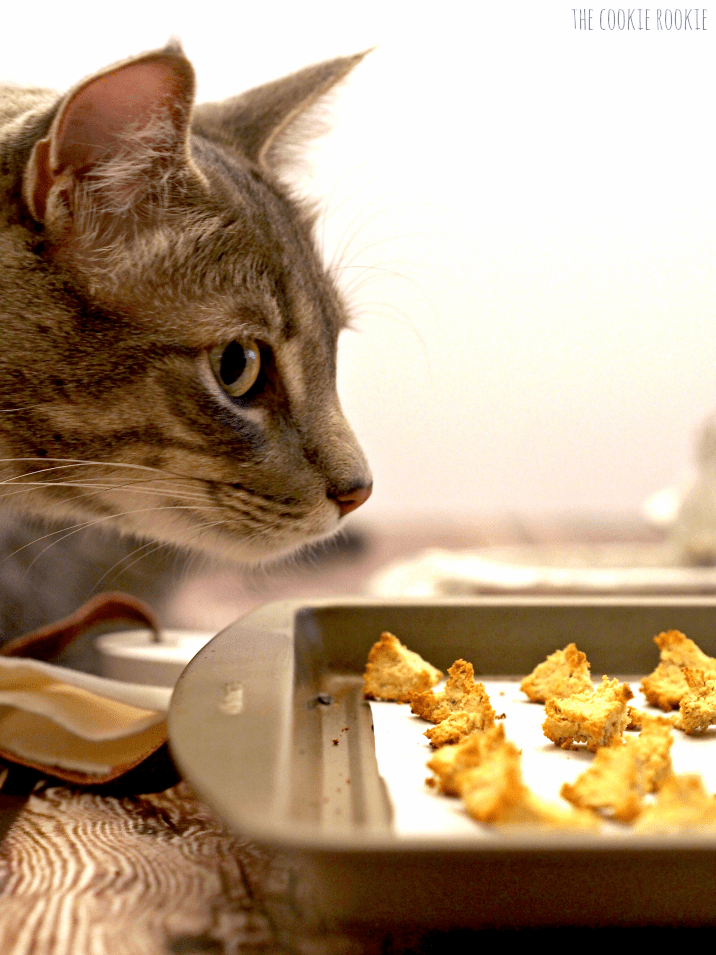
Chef Becky Hardin’s tuna-based cat treats over at The Cookie Rookie inspired this catnip-spiked version. Fair warning: you won’t want these anywhere near your salad.
Ingredients:
- 1 can (5 oz) tuna in water, drained well
- 1 egg
- 1 tablespoon dried catnip
- 1 cup whole wheat flour
Instructions:
- Preheat your oven to 350°F (175°C).
- Mash the drained tuna in a bowl until mostly smooth.
- Mix in the egg and the catnip.
- Stir in the flour a little at a time until a firm dough forms.
- Roll to 1/4 inch thickness and cut into small squares, your “croutons.”
- Bake for 15 to 20 minutes, until lightly browned.
- Cool fully before storing in an airtight container.
Skip this one if your cat has a known fish sensitivity.
Recipe 3: Spinach and Chicken Treats (inspired by Popsugar)

Sarah Lipoff’s organic chicken-and-spinach treat, originally shared on Popsugar, adds a vegetable boost to a protein-forward treat.
Ingredients:
- 1 cup cooked chicken, finely chopped
- 1/4 cup cooked spinach, drained and chopped
- 1 egg
- 1 cup whole wheat flour
Instructions:
- Preheat your oven to 350°F (175°C).
- Combine the chicken and spinach in a bowl.
- Mix in the egg.
- Add flour gradually until the mixture holds together as a dough.
- Roll out and cut into small shapes.
- Bake for 20 to 25 minutes, until firm.
- Cool on a wire rack before serving.
Recipe 4: Organic Chicken Treats (inspired by Modern Cat)

This simple, short-ingredient version is adapted from a recipe shared by Modern Cat. Catnip is optional here, but most cats won’t mind the extra flavor.
Ingredients:
- 1 cup cooked organic chicken, shredded
- 1 cup whole wheat flour
- 1 egg (optional, adds protein and helps bind the dough)
- 1 teaspoon dried catnip (optional)
Instructions:
- Preheat your oven to 350°F (175°C).
- Combine the shredded chicken and flour in a bowl.
- Add the egg and catnip if using, then mix until a dough forms. A splash of water helps if it’s too dry.
- Roll to 1/4 inch thickness and cut into small pieces.
- Bake for 20 to 25 minutes, until firm and lightly golden.
- Cool completely before giving any to your cat.
Recipe 5: Catnip and Honey Treats

Don’t feel like handling raw meat? This one skips it entirely. It’s a simple, healthy cat treat recipe built on whole wheat flour, organic catnip, and honey. Catnip itself is non-toxic to cats in the amounts used here, according to VCA Animal Hospitals (2021), though honey should be used sparingly, especially for diabetic cats, per PetMD (2021).
Ingredients:
- 1 cup whole wheat flour
- 2 tablespoons organic catnip
- 1 tablespoon honey
- 1/3 cup water (a bit more or less as needed)
- Optional: 1 egg (for extra protein, if your cat tolerates eggs)
Instructions:
- Preheat oven: Preheat your oven to 350°F (175°C).
- Mix dry ingredients: In a large bowl, combine the whole wheat flour and organic catnip.
- Add wet ingredients: Stir in the honey. If using an egg, beat it lightly and mix it in now. Gradually add water until the mixture forms a dough that’s firm and pliable but not sticky.
- Roll out dough: On a lightly floured surface, roll the dough to about 1/4 inch thickness.
- Cut out treats: Use a small cookie cutter or a knife to cut bite-sized pieces, any shape your cat will love.
- Bake treats: Place on a parchment-lined baking sheet and bake for 20 to 25 minutes, until lightly browned and firm.
- Cool down: Let the treats cool completely on a wire rack before giving any to your cat.
- Storage: Keep them in an airtight container for a few weeks.
- Serving size: One or two treats a day is usually plenty.