
At 15 years old, Mia should have been spending her days curled up somewhere comfortable, enjoying the familiar routines of a home she had known for years. Instead, the senior cat suddenly found herself at a pound, separated from everything familiar at an age when change can be especially difficult.
Mia was already different from many of the cats around her. She had only three legs, and her age meant she needed a family prepared to embrace the realities of caring for a senior pet. According to Robyn’s Nest and all the Rest Animal Rescue, the reasons given for her surrender included digging in garden beds, not using a litter tray, and a new baby joining the household.
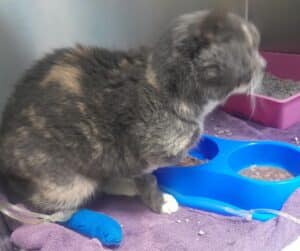
Whatever had happened before, the rescue knew one thing when it learned about Mia: it couldn’t leave her there.
“We couldn’t let Mia stay in the pound, and we vowed to help her no matter what she needed,” the organization shared. That promise would become far more important than anyone realized.
Mia Became Seriously Ill Just Days After Her Rescue
Only a few days after Mia reached safety, her health took a frightening turn. She developed such a severe case of cat flu that she needed to be hospitalized. For a 15-year-old cat already coping with major upheaval, another battle was the last thing her caregivers wanted her to face. Still, Mia rallied. She improved enough to leave the hospital and return to rescue care, offering everyone hope that the worst might finally be behind her.
Unfortunately, another setback soon followed. Mia became constipated, and even a feline laxative failed to resolve the problem. More concerningly, she stopped eating. For an older cat recovering from a serious illness, a loss of appetite can quickly become a significant medical concern. Mia returned to Maryborough Veterinary Practice, where veterinarians began trying to determine what was wrong.
Veterinarians Are Searching for Answers
Mia has undergone extensive testing as her veterinary team searches for an explanation. According to the rescue, she has received multiple blood panels, X-rays, ultrasounds, and other diagnostic care, but so far, the tests have not revealed a clear cause for her condition.
She has needed intravenous fluids while hospitalized, and her continued refusal to eat has become one of the greatest concerns. The uncertainty can be one of the hardest parts of caring for a sick animal. When an obvious diagnosis doesn’t emerge, veterinarians and caregivers are left piecing together test results, symptoms, and changes in behavior while hoping something will point them toward an answer.
Robyn’s Nest worries there could be an underlying problem that has not yet been detected. At the same time, Mia is giving them an important reason to keep hoping. She is still remarkably “chipper.”
At 15, Mia Is Still Fighting
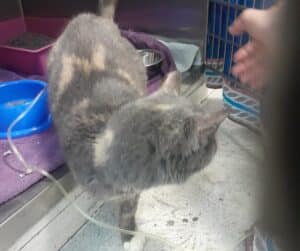
Despite the hospital stays, medical tests, IV fluids, and everything else that has happened in such a short period, Mia’s caregivers don’t see a cat who has lost interest in life.
“She is still quite chipper so it’s not like she has given up on life,” the rescue explained.
That small detail changes the feeling of Mia’s entire story. Her body may be struggling, but there is still a spirited senior cat behind those medical problems. After 15 years of life, the loss of her home, a severe illness, and another unexplained health crisis, Mia is still showing the people around her that she is here.
Now they desperately need her appetite to follow. Eating is particularly important for cats because going without adequate nutrition can create additional medical problems. For a senior cat who is already unwell, getting enough calories and nutrients becomes an important part of supporting the body through illness and recovery.
Mia cannot remain connected to an IV indefinitely, and her rescuers are hoping she will soon reach the turning point everyone is waiting for: voluntarily eating again.
Senior Pets Can Face an Especially Difficult Transition
Mia’s story also highlights the vulnerability of older animals when they lose their homes. A 15-year-old cat may have spent well over a decade becoming accustomed to particular people, smells, sleeping places, feeding times, and household routines. Suddenly entering a pound or rescue environment can mean adjusting to unfamiliar surroundings; at the same time, age-related medical needs may be becoming more complicated.
Three-legged cats can adapt remarkably well to life on three limbs, but Mia’s combination of advanced age and current illness means she needs caregivers willing to look at the whole cat rather than seeing only a list of challenges. That is exactly what Robyn’s Nest and all the Rest Animal Rescue is trying to do.
The organization knew Mia was an older, three-legged cat when it stepped forward. What rescuers could not have anticipated was how quickly her needs would escalate or how expensive her veterinary care would become. Still, their promise hasn’t changed.
‘We Were Not Going to Let That Happen Again’
Mia’s repeated hospitalizations and extensive diagnostic testing are expected to leave the rescue with significant veterinary expenses. The organization is raising support for her treatment while continuing to pursue answers with her veterinary team.
But underneath the tests, bills, medications, and uncertainty is something much simpler. A senior cat that needed someone.
Mia had already lost the home she knew. When Robyn’s Nest found her at the pound, the rescue decided that whatever came next, she would not face it without people fighting for her.
“She has been let down once by humans and we were not going to let that happen again,” the rescue shared.
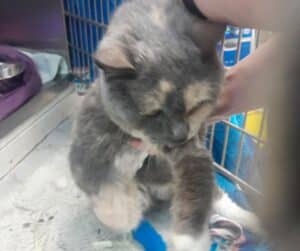
No one yet knows exactly what Mia’s next chapter will look like. Her caregivers are realistic about the seriousness of her condition, particularly while she continues refusing food. But they are also paying attention to the cat in front of them, and right now, Mia is still engaged with life.
At 15 years old and on three legs, she has already adapted to more than most animals ever should. What her rescuers want for her now isn’t complicated. They want her to eat. They want her to be comfortable. And after losing the security she once knew, they want her to have the opportunity to spend whatever time lies ahead knowing that she belongs somewhere.
Their message to the little senior cat says it best. “Please start eating again Mia,” the rescue wrote. “We want to give you a happy rest of your life.”