
Male calico cats do exist, but they’re genuinely rare, and most estimates put them at roughly 1 in 3,000 calico cats. Almost all calicos are female because the orange and black coat colors are both carried on the X chromosome, and a cat needs two different X chromosomes, one orange and one black, for the patchwork pattern to show. Each cell randomly switches off one of its X chromosomes, a process called X-inactivation, and that’s why the patches look scattered rather than blended. A typical male cat has only one X chromosome (XY), so he can’t carry both color genes at once.
Calico Coat And Fertility By Chromosome Pattern
The rare exception is a male born with an extra X chromosome (XXY) instead of the usual XY, a condition called Klinefelter syndrome, and that spare X is what lets him show both colors the way a female does. Nearly all male calicos with this XXY pattern are sterile, so it isn’t a trait anyone can breed for on purpose.
Evidence-reviewed, not hands-on tested.
Calico cats are lovely and unique. Even more unique is the fact that they are nearly always female. I can take advantage of my knowledge of this to impress my clients by correctly guessing the gender of their cat from a distance! Although it can make me seem magical, science makes my skill much less impressive. Why are male calico so rare?
To answer this question, we have to first examine what calico is and why any cat has this interesting coat color. The word “calico” can refer to a printed fabric (as in a calico cotton dress), but the term is now most commonly associated with cats. A calico cat will have areas of black, white, and orange scattered all over her body. Usually the cat’s body is mostly white and the other two colors disperse across them in large and small patches.
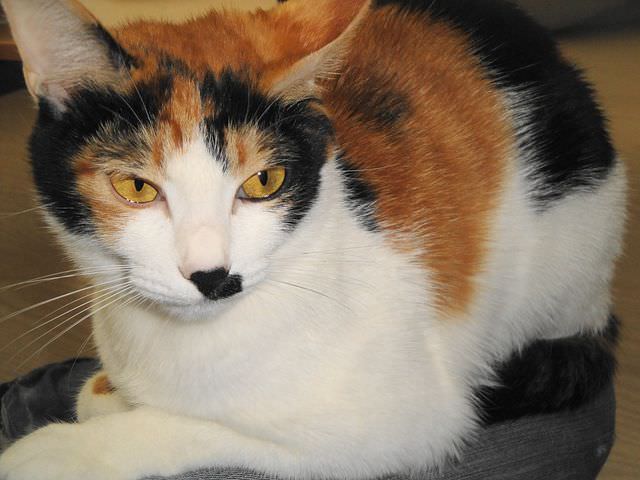
The patches are actually the visual expression of the cat’s DNA. You see, the colors are coded on the cat’s gene map. But it just so happens that each of these colors are coded on the X chromosome. In a female cat, who has XX pairs, the orange-expressing X shows in some areas and the black-coded X shows in others, because each cell randomly switches off one of its two X chromosomes in a process geneticists call X-inactivation.
In a male cat, who has only one X chromosome, the two colors are not able to express in this way. In fact, in order for a male cat to even carry and express both of these colors, he must have a genetic rarity known as Klinefelter syndrome. Klinefelter males have an extra X chromosome, so their genetic map is XXY. Because of the presence of the two X chromosomes, Klinefelter males can appear calico. Klinefelter syndrome is named after the doctor who first described it in humans. It a rare genetic defect in human beings, only occurring at a rate of 0.2%1, but it is likely even less common for cats. Current human genetics data from MedlinePlus Genetics puts Klinefelter syndrome at about 1 in 500 to 1 in 1,000 newborn boys.
If you have a calico male cat, he is very rare indeed. But sadly, these cats are usually sterile so this trait cannot be purposefully selected for, a finding documented in the Centerwall and Benirschke survey of male tortoiseshell and calico cats and consistent with the infertility seen in human Klinefelter syndrome. If you have a female calico, she is also a unique and interesting visual reminder of how complex and beautiful genetics can be!
Do you love learning about cats? I love sharing about them. Learn more by finding me on Facebook by clicking here.
- Centerwall WR, Benirschke K. An animal model for the XXY Klinefelter’s syndrome in man: tortoiseshell and calico male cats.Am J Vet Res. 1975 Sep;36(9):1275-80. PubMed PMID: 1163864.